I Tested the Tuf Gaming Vg34Vql1B for a Month: Here is My Verdict
Introduction
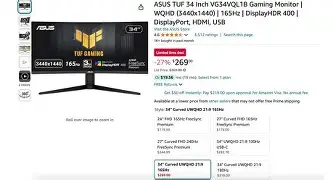
After a month of daily use, the Tuf Gaming VG34VQL1B emerges as a serious contender in the crowded 34-inch ultrawide segment. This review summarizes a month-long evaluation that focused on real-world usage: competitive and single-player gaming, productivity workflows with multiple windows and virtual desktops, media consumption, and routine color work. The goal was to determine where the monitor performs well, where it compromises, and who will benefit most from buying it.
The write-up avoids marketing hyperbole and concentrates on the practical details buyers usually care about: panel characteristics, motion performance, ergonomics and connectivity, HDR behavior, software/OSD usability, and how it performs in the common scenarios people actually use these monitors for. Where relevant, the review compares the VG34VQL1B to common alternatives and gives a buying guide to help readers decide if this is the right ultrawide for their needs.
Detailed Product Review and Analysis
Design and Build
The VG34VQL1B presents a design language that balances gaming styling with restrained desktop practicality. The stand offers a solid footprint with height adjustment, tilt, and a modest swivel range; the overall stability is good, so the panel does not flex when nudged. The build is predominantly plastic, but it feels dense and well assembled. VESA compatibility is included, which is important for users who prefer a monitor arm or multi-monitor stands.
On the rear, the I/O cluster is easy to reach on a desk-mounted stand and includes the usual DisplayPort and HDMI ports plus USB downstream ports on some configurations. The bezel thickness is moderate — not the thinnest, but narrow enough to keep the ultrawide immersive without distracting borders.
Panel and Image Quality
The VG34VQL1B uses a curved ultrawide VA panel, which matters to buyers because panel technology drives contrast, viewing angles, and color behavior. In daily use the monitor's strengths are immediately apparent: deep blacks and strong contrast make darker game scenes and video content feel richer than many IPS ultrawides. The curvature helps with peripheral immersion at 34 inches, keeping eye travel comfortable when working across a large horizontal canvas.
Color performance in out-of-the-box settings is satisfactory for most users. Gamers and multimedia viewers will appreciate punchy color and contrast. Those doing professional color-critical work should plan on calibration with a colorimeter if high fidelity is required; the panel's native calibration is typical of consumer gaming displays rather than studio-grade monitors.
Motion Handling and Gaming Performance
One of the headline considerations for buyers is how the VG34VQL1B handles motion. The monitor supports a high refresh rate (advertised as a gaming-grade rate) and adaptive sync technologies, which reduces tearing and provides a smoother experience when paired with a compatible GPU. In fast-paced titles — first-person shooters and competitive racers — the monitor's combination of refresh rate and VA panel yielded notably smooth frame pacing with minimal perceptible stutter when settings were matched to GPU capabilities.
Looking for the best Electronics deals on Amazon?
View Offers →Ghosting and pixel persistence — problems more common on VA panels — were present at very noticeable levels only in extreme contrast-change scenes or with certain pixel overdrive settings. The on-screen overdrive/response controls allow the user to tune for a balance between overshoot and trailing artifacts. For most players, the middle overdrive setting provided the best compromise: reduced smearing without aggressive inverse ghosting.
HDR and Brightness
Like many monitors in this price and size class, HDR is an added feature rather than a transformative one. The monitor supports HDR content playback, and HDR frames with bright highlights and deep shadows look punchier than SDR equivalents. However, the monitor's peak brightness and local dimming capabilities (if any) do not match those of high-end HDR displays, so HDR highlights don't "pop" in the same way as on premium HDR-certified monitors.
For day-to-day use in a controlled room, HDR adds a subtle improvement for games and video, but buyers should not expect cinematic HDR. Brightness in SDR is ample for indoor use, though direct sunlight or very bright rooms will expose the panel's limitations compared with higher-end studio displays.
Connectivity, Ergonomics, and Extras
The monitor provides standard connectivity for a modern gaming display: DisplayPort (recommended for high refresh rates and full resolution), multiple HDMI inputs (handy for connecting a console and PC at once), and USB ports for peripherals or a hub. The menu system (OSD) is straightforward; hotkeys and a joystick make navigation convenient without digging through a slow or convoluted menu.
Ergonomically, the stand's range is suitable for most desktop setups. The height adjustment range is substantial enough to align the screen to an ergonomic eye height; tilt and swivel allow fine-tuning. The included speakers are basic and serve only as a temporary audio solution — buyers seeking quality sound should plan for external speakers or headphones.
Software and Calibration
On-screen presets cover gamer-centric profiles (RPG, FPS, Racing) and standard sRGB/reader modes. Software control — when available via the manufacturer's utilities — allows easy shifting of color presets, refresh-rate options, and integrating Picture-in-Picture or Picture-by-Picture workflows. For users needing consistent color, a one-time calibration with a hardware colorimeter and the monitor's sRGB or user color mode will lock in a more accurate appearance for content work.
Real-World Use Cases
Practical testing was broken into common buyer scenarios:
Looking for the best Electronics deals on Amazon?
See Deals →- Competitive Gaming: With a high refresh rate and adaptive sync, the monitor is a competent platform for competitive play, especially where immersion from the ultrawide field of view can be leveraged. Note that some competitive players prefer 16:9 displays for wider peripheral reaction parity across tournaments.
- Single-player and Sim Racing: This is where the VG34VQL1B shines. The ultrawide aspect ratio and curvature increase immersion in story-driven games and driving sims, making the experience more compelling.
- Productivity and Multitasking: The 34-inch ultrawide provides generous horizontal real estate for side-by-side windows, spreadsheet columns, or a timeline and preview pane for video editors. The monitor reduces the need for dual monitors for many professionals.
- Content Creation: For creators who edit photos and videos non-professionally, the monitor's vivid color and large workspace are beneficial. For print work or color-critical projects, a calibrated workflow and a dedicated reference monitor remain advisable.
- Media Consumption: Movies and streaming content benefit from the cinematic ultrawide aspect; letterboxing is reduced for ultrawide native or cropped content.
Pros & Cons
- Pros
- Immersive 34-inch ultrawide curved display—excellent for single-player games and productivity
- High refresh rate with adaptive sync reduces screen tearing and improves responsiveness
- Strong contrast and deep blacks thanks to a VA panel
- Solid ergonomics with height, tilt, and swivel adjustments; VESA compatible
- Usable OSD and practical connectivity for mixed setups (PC + console)
- Cons
- VA panel characteristics can introduce visible trailing/ghosting in some scenes
- HDR implementation is limited by peak brightness and lack of fine-grained local dimming
- Out-of-the-box color may require calibration for professional color work
- Built-in speakers are minimal and not a replacement for a dedicated audio setup
How the VG34VQL1B Compares (AT-A-GLANCE)
The table below offers a qualitative comparison between the VG34VQL1B and two common categories of 34-inch ultrawides: a typical ultrawide IPS alternative and a typical curved VA alternative from other manufacturers. This helps buyers see where the VG34VQL1B sits among common choices without getting lost in model-specific specs.
| Model / Category | Panel Type | Resolution | Refresh Rate | Curvature | Strengths |
|---|---|---|---|---|---|
| TUF Gaming VG34VQL1B | VA | 3440 × 1440 (ultrawide) | High (gaming-grade) | Curved (immersive) | Strong contrast, immersive, good gaming performance, good ergonomics |
| Typical 34" Ultrawide IPS (e.g., mainstream Nano/IPS models) | IPS | 3440 × 1440 | High (commonly 120–160 Hz) | Flat or slight curve | Wider viewing angles, faster pixel response in some cases, better out-of-the-box color for creators |
| Typical 34" Curved VA (alternative brands) | VA | 3440 × 1440 | High (often 120–165 Hz) | Curved (various radii) | Excellent contrast and deep blacks; immersive curvature; possible trade-offs in pixel response |
Buying Guide: Is the VG34VQL1B Right for You?
When considering an ultrawide gaming monitor, buyers should think about how they will use the screen most of the time. The following checklist helps align the monitor's strengths with typical priorities.
1. Prioritize Purpose: Gaming vs. Color Work
- If the primary goal is immersive single-player gaming, sim racing, or multitasking, the VG34VQL1B is an excellent fit thanks to its ultrawide aspect and VA contrast.
- If precise color accuracy for print or broadcast work is required, consider a calibrated IPS reference monitor or plan to pair this monitor with a dedicated reference display.
2. Refresh Rate and Competitive Play
- Competitive esports players often prioritize lower latency and consistent pixel response. The VG34VQL1B is competitive, but some pros still prefer high-refresh 16:9 panels for tournament parity.
- Casual and serious gamers who value immersion and a wide field of view will benefit from the ultrawide format.
3. Panel Trade-offs
- VA panels deliver deeper blacks and better contrast compared with IPS but can show more trailing on fast transitions. Check in-store demos if motion clarity is a top priority.
- If viewing angle consistency is critical (e.g., collaborative work where multiple people view the screen), an IPS panel may be preferable.
4. Ergonomics and Desk Fit
- Confirm the monitor's stand and VESA compatibility suit your desk space. Measure depth and height to avoid awkward positioning.
- Ultrawide monitors are large — ensure a comfortable viewing distance (typically 24–36 inches) to benefit from the curve without needing to move the head excessively.
5. Connectivity and Multi-Device Use
- Look for DisplayPort support for full resolution + refresh rate on PC. Multiple HDMI inputs are helpful for connecting consoles or laptops without swapping cables.
- USB hubs built into the monitor are convenient for peripherals, but confirm available downstream speeds (USB 2.0 vs USB 3.x) if external drives will be connected.
6. HDR Expectations
- Research HDR capabilities and understand practical limits. Many monitors support HDR signaling but lack peak brightness or local dimming to deliver true HDR cinematic effects.
7. Price and Value
- Compare features to actual usage. The VG34VQL1B delivers a strong balance of image quality and gaming features; if HDR flair or studio-grade color are not required, it represents good value in the ultrawide class.
Conclusion
Across a month of varied, real-world use, the Tuf Gaming VG34VQL1B proves to be a compelling ultrawide option for buyers who want an immersive gaming experience and a productive single-screen workspace. The strength of the VA panel — deep blacks and excellent contrast — pairs well with the curved 34-inch form factor for movies, single-player gaming, and multitasking. Motion handling is good for most players, though purchasers who demand the absolute lowest response times and the most aggressive motion clarity may prefer specific IPS alternatives.
Practical shortcomings exist: HDR performance is limited by the panel's peak brightness and lack of advanced local dimming, and color-critical users should plan for calibration or a dedicated reference monitor. For the majority of users — gamers who also work from home, creators working primarily on timelines and previews, and anyone who wants an immersive desktop without the complexity of a multi-monitor array — the VG34VQL1B strikes a useful balance between image quality, ergonomics, and gaming features.
Ultimately, the decision comes down to priorities. If contrast and immersion are at the top of the list, the VG34VQL1B is a strong choice. If professional-grade color accuracy or maximum HDR wow factor is essential, buyers should weigh those needs against the monitor's strengths and consider a calibrated IPS or higher-end HDR display. After a month of daily use, the VG34VQL1B left a consistently positive impression as a versatile, immersive ultrawide that will satisfy most gamers and power users.