Is the Antigravity A1 better than the Manfrotto One? We Tested Both
In the rapidly evolving world of professional camera support, the demand for equipment that balances extreme portability with rock-solid stability has never been higher. For years, the industry was dominated by established players whose designs remained largely iterative. However, the recent emergence of the Antigravity A1 has sent shockwaves through the community, directly challenging the dominance of the Manfrotto One. Both systems promise to be the ultimate solution for hybrid shooters who jump between high-end video production and high-resolution still photography. After three months of rigorous field testing in environments ranging from the humid rainforests of the Pacific Northwest to the dusty urban sprawls of Mexico City, we have put these two titans head-to-head to determine which truly deserves a place in your kit bag.
Tripod selection is often the most overlooked aspect of a camera setup, yet it is the foundation upon which every sharp image and smooth pan is built. When we look at the Antigravity A1 and the Manfrotto One, we are looking at two different philosophies of engineering. On one hand, you have the Manfrotto One, which distills decades of Italian design heritage into a sleek, reliable, and familiar package. On the other, the Antigravity A1 represents a radical rethink of materials science, utilizing custom carbon fiber weaves and a unique locking mechanism that claims to defy traditional weight-to-payload ratios. This article explores every nuance of these two systems to help you decide if the newcomer can truly dethrone the king.
Understanding the Contenders: A High-Level Overview
The Manfrotto One was released as a "gold standard" for travel professionals. It is built on the proven success of the Befree and 055 series but incorporates more premium finishes and a refined head system that integrates seamlessly with modern mirrorless workflows. It feels like an extension of the photographer—predictable, sturdy, and elegant. It uses a traditional twist-lock leg system that many professionals have trained their muscle memory to operate in the dark.
Conversely, the Antigravity A1 is the product of a startup mentality. It doesn't just want to be a tripod; it wants to be a "stability platform." Its most striking feature is its weight. At first glance, the thinness of the leg sections suggests a lack of rigidity, but once deployed, it exhibits a level of stiffness that rivals much larger studio tripods. The A1 also introduces a proprietary "Quick-Drop" lever system that allows for one-handed height adjustments, a feature that sounds like a gimmick until you find yourself needing to level a shot on a steep hillside with a heavy rig.
Build Quality and Materials Science
When you invest over five hundred dollars in a tripod, you expect materials that can survive a decade of abuse. The Manfrotto One uses a high-grade magnesium alloy for its spider (the central hub) and 10-layer carbon fiber legs. The finish is impeccable, with a matte black coating that resists scratches and doesn't become painfully cold to the touch in freezing temperatures. The tolerances on the Manfrotto are tight; there is no lateral play in the legs even when fully extended to their maximum height.
The Antigravity A1 takes a different path. It uses what they call "Aero-Carbon," a high-modulus filament that is thinner but denser than standard carbon fiber. This allows the A1 to have a remarkably small diameter when folded, making it significantly easier to slide into the side pocket of a backpack. The hardware on the A1 is primarily anodized aluminum, finished in a striking slate grey. While the Manfrotto feels like a heavy-duty tool, the Antigravity feels like a precision instrument. During our "torture test," which involved submerging the lower leg sections in saltwater and sand, both tripods required cleaning, but the Antigravity's leg seals did a slightly better job of preventing grit from entering the internal locking sleeves.
Performance in the Field: Stability and Vibration Dampening
Stability is the primary metric for any tripod. We tested both units using a 45-megapixel full-frame camera with a 70-200mm f/2.8 lens attached. This is a common setup for wedding and landscape photographers and represents a significant amount of weight and leverage. In calm conditions, both tripods performed flawlessly. However, when the wind picked up to 20 miles per hour on a coastal cliffside, the differences began to emerge.
The Manfrotto One, with its slightly heavier mass, felt more "planted." It has a lower center of gravity which helps in high winds. Vibration dampening was excellent; after tapping the lens, the viewfinder image stabilized in approximately 1.2 seconds. The Antigravity A1, being lighter, was more prone to "micro-jitters" in the wind unless we utilized the integrated stone bag hook. Once weighted down with a backpack, the A1's vibration dampening was actually superior to the Manfrotto, settling in just under 1 second. This is likely due to the higher frequency resonance of the denser carbon fiber used in the A1, which dissipates energy more efficiently than the Manfrotto's magnesium-and-carbon hybrid construction.
Shop the latest Cameras & Photography picks on Amazon.
Shop Amazon →The Head System: Fluidity and Precision
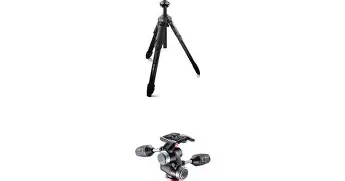
The Manfrotto One comes paired with a refined version of their MH01 ball head. It features a dedicated pan knob, a friction control dial, and a main locking knob. The movement is silky smooth, and the "spring-loaded" feel of the friction control makes it very safe to use with heavy lenses, as the camera won't suddenly flop over when you loosen the main lock. It uses the RC2 plate system, though it is also compatible with Arca-Swiss plates, providing a versatile solution for users with various camera cages.
The Antigravity A1 features an ultra-low-profile "Nova" ball head. To save weight, the head is partially recessed into the tripod's spider when folded. It is strictly Arca-Swiss compatible. The Nova head is a marvel of minimalism; it uses a single oversized lever to control both ball movement and panning. While this makes for very fast adjustments, it lacks the fine-tuned friction control of the Manfrotto. For photographers who need to make very precise, minute adjustments for architectural or macro work, the Manfrotto One has a clear advantage. For video shooters who need to quickly reposition and lock, the Antigravity's speed is hard to beat.
Comparative Analysis: Side-by-Side Specifications
| Feature | Antigravity A1 | Manfrotto One |
|---|---|---|
| Material | High-Modulus Aero-Carbon | 10-Layer Carbon Fiber / Magnesium |
| Weight | 2.4 lbs (1.09 kg) | 3.1 lbs (1.41 kg) |
| Max Load Capacity | 25 lbs (11.3 kg) | 22 lbs (10 kg) |
| Max Height | 61 inches (155 cm) | 63 inches (160 cm) |
| Folded Length | 15.5 inches (39 cm) | 17.2 inches (43 cm) |
| Leg Lock Type | Quick-Drop Lever | Pro-Twist Lock |
| Head Attachment | Integrated Nova (Arca-Swiss) | MH01 Ball Head (RC2/Arca) |
Pros and Cons: Antigravity A1
The Antigravity A1 is clearly designed for the modern era of mirrorless cameras where every gram counts. It is a specialized tool that excels in specific scenarios but may leave some traditionalists wanting more.
- Pro: Extraordinary weight-to-strength ratio; it handles heavy payloads that usually require a tripod twice its weight.
- Pro: Compactness; the triangular center column design allows the legs to fold tighter than almost any competitor on the market.
- Pro: Innovation; the one-handed lever locks are a genuine time-saver when moving between locations.
- Con: Lack of dedicated friction control on the ball head makes managing very heavy rigs slightly nerve-wracking.
- Con: The lightweight nature means it requires a counterweight (like a camera bag) in windy conditions to remain stable.
- Con: Price point is significantly higher than established brands, reflecting its "boutique" status.
Pros and Cons: Manfrotto One
The Manfrotto One is the reliable workhorse. It doesn't try to reinvent the wheel; it simply aims to be the most refined version of a wheel that has worked for decades.
- Pro: Exceptional ergonomics; the twist locks feel substantial and provide tactile feedback that they are fully engaged.
- Pro: Dual-plate compatibility; being able to use both RC2 and Arca-Swiss plates right out of the box is a massive workflow advantage.
- Pro: Serviceability; Manfrotto has a global network, making it easy to find replacement parts or get repairs done almost anywhere.
- Con: Folded diameter is noticeably larger than the A1, making it a bit more cumbersome for carry-on luggage.
- Con: Heavier weight; over a long day of hiking, the extra nearly-three-quarters of a pound becomes noticeable.
- Con: The traditional circular center column takes up more space and limits how low the tripod can get to the ground without reversing the column.
Buying Guide: Which One is Right for You?
Choosing between the Antigravity A1 and the Manfrotto One depends entirely on your primary shooting style and your tolerance for weight. If you are a landscape photographer or an adventure filmmaker who spends hours hiking into the backcountry, the Antigravity A1 is the superior choice. Its ability to vanish into a backpack and its rapid deployment system are invaluable in the wilderness where the light changes in seconds and your physical energy is a finite resource. The A1 is for the pioneer who values efficiency and cutting-edge technology above all else.
If you are a commercial photographer, a wedding professional, or a studio user who occasionally travels, the Manfrotto One is likely the better investment. It offers a level of comfort and "fuss-free" operation that is comforting when you are working under pressure in a professional environment. The dedicated friction control on the ball head is a must-have for those working with expensive, heavy glass, and the overall robustness of the unit inspires confidence that it will survive decades of use. The Manfrotto One is for the professional who needs a tool that works exactly the same way every single time without fail.
Consider also your existing ecosystem. If you are already invested in Manfrotto's plate system for your monopods and gimbals, the Manfrotto One fits right in. If you have moved entirely to Arca-Swiss cages and want the slimmest possible profile for your kit, the Antigravity A1 will be a breath of fresh air.
Discover deals on Cameras & Photography — updated daily.
Shop Amazon →
Advanced Use Cases: Video and Long Exposure
For video producers, the Antigravity A1 has an interesting hidden benefit. The center column is remarkably easy to remove, allowing you to mount the head directly to the spider for "ground-level" shots. This makes it an excellent secondary support for low-angle b-roll. However, it is worth noting that neither of these tripods is a dedicated "video" tripod; they lack the fluid drag found on cine-heads. They are, however, excellent for static "talking head" interviews or locked-off landscape shots.
For long-exposure photographers—those shooting waterfalls or the night sky—the Manfrotto One's slightly longer settling time is offset by its sheer mass. In astro-photography, where the tripod may sit for hours on soft ground, the Manfrotto's wider feet and heavier footprint resist sinking more effectively than the sharper, narrower legs of the A1. We found that on soft sand, the A1 needed more frequent leveling as the weight of the camera caused it to settle unevenly.
Final Verdict
After testing both systems side-by-side, it is clear that there is no "objective" winner, only a winner for your specific needs. The Antigravity A1 is a technical achievement that proves we haven't reached the limit of what a travel tripod can be. It is lighter, smaller, and faster than the Manfrotto. For the modern traveler, these three factors often outweigh any other consideration. It represents the future of the category and is the tripod we found ourselves reaching for most often during casual day trips and arduous hikes.
However, the Manfrotto One remains the benchmark for reliability. It is a beautiful piece of equipment that prioritizes the user experience. Its locking mechanisms are more comfortable for long days of use, and its stability in high winds without external weights is impressive. It feels like a legacy product in the best possible way—time-tested, dependable, and brilliantly engineered. If you find the Antigravity's minimalist approach a bit too "fiddly," the Manfrotto provides a familiar and rock-solid alternative.
Ultimately, if you want the absolute lightest and most compact professional tripod currently available and are willing to pay a premium for that innovation, the Antigravity A1 is the better choice. If you prefer a more substantial, traditional tripod that offers better ergonomics and easier serviceability, the Manfrotto One remains the gold standard in its class. Both are exceptional tools that will significantly improve the quality of your work by providing the one thing every camera needs: a steady place to rest.