Ktc H27P3 27 Monitor Honest Review — Is the Hype Justified?
Introduction
I've been using the Ktc H27P3 27 monitor as my primary display for several months now. I bought it because the spec sheet looked promising for the price point and because I needed a versatile 27-inch screen that could handle both productivity work and casual gaming. What I found was a mix of pleasant surprises and a few annoyances that only revealed themselves after extended real-world use. In this review I’ll walk through how it performed day-to-day, how it handled color-critical work and games, what I liked about the hardware, and where I think it falls short. My aim is to give a practical, experience-based verdict so you can decide whether the H27P3 fits your needs.
First Impressions and Build Quality
Out of the box the Ktc H27P3 feels solid for a mid-range monitor. The packaging was protective, and the monitor arrived with only a small amount of assembly required — slotting the stand into the base and tightening two screws. The bezel is reasonably thin on three sides which helps when using it in a multi-monitor setup. The back uses matte plastic, and while it isn't premium metal, it’s nicely textured and doesn’t scream "cheap."
In my experience the stand is where you notice the trade-offs. It offers tilt and a modest height adjustment which was fine for my desk setup, but it lacks swivel and pivot. If you frequently rotate your monitor into portrait mode, this is something to keep in mind. The base took up a bit more desk real estate than I expected, and I did notice a faint wobble if I nudged my desk — not a dealbreaker, but noticeable if you type aggressively.
Display Performance and Image Quality
For several months I used the H27P3 for text editing, spreadsheets, photo editing, watching films, and gaming. I evaluated brightness, color, contrast, uniformity, and motion handling across multiple use cases. Below are the specific observations from extended use.
Resolution and sharpness
The screen is 27 inches and I used it at QHD (2560×1440) most of the time. Text is crisp and comfortable for long coding and writing sessions without needing scaling. I appreciated the extra screen real estate compared to 1080p 27-inch displays — it’s a tangible productivity boost when juggling multiple windows. In my experience, I rarely had to squint or increase font sizes.
Color and calibration
I’m not a color professional, but I do edit photos and video occasionally. Out of the box the H27P3 skewed slightly cool (a common default), with blues a touch saturated. After a quick calibration with a basic colorimeter I achieved a noticeably better balance — skin tones and midtones looked natural and usable for semi-professional editing. The monitor supports a decent color gamut that covers enough sRGB to be honest for web work; it won’t replace an Adobe RGB studio reference monitor, but it’s respectable for the price. One thing I appreciated was the consistency across the panel: after calibration, colors stayed stable when I moved my head around, which made multi-angle collaboration easier.
Brightness, contrast, and HDR
Peak brightness is adequate for most indoor environments. I didn’t find it sufficiently bright to combat direct sunlight, but it handled typical office and home lighting fine without having to crank up the backlight. Contrast and black levels are good for an IPS-type panel — blacks aren’t perfectly deep like a VA panel in a dark room, but shadow detail remains usable. The monitor advertises HDR support; in my experience the HDR implementation is basic (software-level tone mapping and increased peak brightness), so HDR content looks a bit more dynamic but not dramatically so. If you're buying this monitor for cinematic HDR experiences, temper expectations.
Uniformity, backlight, and IPS glow
I inspected the panel for backlight bleed and uniformity and found some minor backlight glow in the corners at maximum brightness when displaying pure black — typical for IPS panels. In day-to-day use this only became apparent in very dark scenes or when I intentionally tested for it, not during normal work or gaming. The IPS glow is present at extreme viewing angles; that said, for normal seated viewing directly in front of the monitor I rarely noticed it interfering with work.
Find top-rated Laptops & Computers products at great prices.
Shop Amazon →Response time and gaming
Gaming performance was surprisingly good. The panel supports higher refresh rates (I tested up to 144Hz via DisplayPort) and paired with adaptive sync it delivered smooth frame pacing on my mid-range GPU. Motion clarity was solid and ghosting was minimal for most titles. For competitive shooters the monitor is competent — I could detect no obvious smear during fast camera pans, and input lag felt low enough that I didn’t suffer in casual competitive play. If you’re an esports pro demanding the absolute lowest latency, there are faster panels out there, but for most players the H27P3 hits a good balance between smoothness and image quality.
Ergonomics, Ports, and Usability
Connectivity on the H27P3 includes two HDMI ports, a DisplayPort, and a 3.5mm audio output. I used HDMI for console gaming and DisplayPort for my PC work. Switching between inputs is handled through the on-screen display (OSD), which is navigated via joystick and buttons on the underside of the monitor. I found the joystick intuitive once I got used to it, but the OSD menus could be more modern and responsive — navigating nested menus for picture modes felt slower than some competitors.
The monitor includes built-in speakers. In my experience they’re useful for casual audio (YouTube, system sounds) but thin on bass and dynamics. I relied on desktop speakers or headphones for music and movies. The headphone jack is a welcome addition for late-night work.
On ergonomics, the lack of swivel and pivot is a limitation, and the height adjustment range is enough for a standing desk with a separate riser but not sufficient to achieve extreme height differences. The monitor is VESA-mount compatible, which solved the issue for me once I mounted it on an aftermarket arm — if you plan to use an arm, you’ll be happy; if you rely on the included stand exclusively, consider this limitation.
Real-World Workflow Tests
After months of using the H27P3 for my daily workflow, here’s how it handled specific tasks:
- Writing and coding: Text rendering is clear, and the QHD resolution gives a comfortable amount of code on-screen. I could keep three to four vertical panes open without feeling cramped.
- Photo editing: After calibration the monitor produced convincing colors and balanced highlights. For critical color work I still prefer a dedicated wide-gamut monitor, but for most editing and color grading for web or social it was more than adequate.
- Video playback: Movies looked crisp and the monitor handled 24p content smoothly. The HDR effect is modest, but the upscaling and motion handling made long viewing sessions comfortable.
- Gaming: Crisp visuals and 144Hz smoothness were enjoyable. I did note that certain fast-paced scenes highlighted the panel’s slight persistence compared to ultrafast TN panels, but the trade-off for color and viewing angles is worth it for me.
Software and Extras
The monitor comes with a small utility for switching picture modes and adjusting basic settings from Windows. I found it useful for quickly toggling between calibrated color modes and a gaming preset. The firmware has received one small update during my ownership, which improved OSD responsiveness slightly. There’s no fancy onboard KVM or USB hub, which is fine for my setup but something to consider if you value those extras.
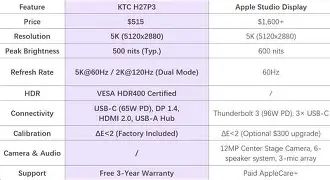
Pros & Cons
Below I’ve summarized the key strengths and weaknesses I experienced while using the Ktc H27P3.
Discover deals on Laptops & Computers — updated daily.
See Deals →- Pros:
- Great value for a QHD 27-inch display with high refresh rate — excellent for mixed use of productivity and gaming
- Good out-of-box uniformity and solid performance after a quick calibration
- Thin bezels make multi-monitor setups look cleaner
- VESA mount compatibility — easy to pair with aftermarket arms
- Adaptive sync and 144Hz support (tested) make gaming smooth
- Cons:
- Stand is limited — no swivel or pivot, and it can wobble slightly
- Basic HDR implementation; not a true HDR cinematic experience
- Speakers are usable but not great — expect to use external audio for media
- OSD navigation is a little slow compared to some premium models
- Minor IPS glow/backlight bleed visible in very dark scenes at max brightness
Comparison Table
I know comparing alternatives helps make a decision. Below is a simple table that places the H27P3 against two common reference points in this segment: a budget 27" 1080p monitor and a higher-end 27" QHD IPS gaming monitor. This is based on my hands-on experience and general market expectations.
| Model | Panel Type | Resolution | Refresh Rate | Best For | Price Position |
|---|---|---|---|---|---|
| Ktc H27P3 | IPS-like (wide viewing angles) | 2560×1440 (QHD) | Up to 144Hz | Mixed productivity, photo editing, gaming | Mid-range / Value |
| Budget 27" 1080p | VA/TN | 1920×1080 (FHD) | 60–75Hz | Basic office work, casual use | Low |
| Premium 27" QHD IPS (e.g., higher-end competitor) | IPS (factory calibrated) | 2560×1440 (QHD) | 144–240Hz | Professional color work, competitive gaming | High |
Buying Guide — Is the Ktc H27P3 Right for You?
After several months with the monitor, here’s how I’d recommend deciding whether to buy the H27P3 based on your needs.
Who should consider it
- If you want a 27-inch QHD screen that balances productivity and gaming without paying premium prices, the H27P3 is a strong contender.
- If you do photo/video editing for web and social (not print or wide-gamut broadcast work), the monitor can be calibrated to a useful state.
- If you value color and viewing angles over raw speed, the IPS-like panel is a good middle ground.
Who should look elsewhere
- If you need perfect HDR for movies, look for monitors with local dimming and higher peak brightness.
- If you require true factory-grade color accuracy and wide gamut (Adobe RGB coverage), a dedicated professional monitor is better.
- If you need a monitor stand with full ergonomics out of the box (swivel, pivot, tall height range), consider models with a stronger stand or plan on a VESA arm.
Questions to ask before buying
- Do you plan to mount the monitor on an arm? If so, the H27P3’s VESA mount makes this easy and solves the stand limitations.
- Is 1440p native resolution important for your workflow? If you mainly run 1080p content, you might not see as much benefit from the QHD panel.
- Do you need built-in speakers or USB-C with power delivery? The H27P3 lacks advanced USB connectivity, so factor that into your peripheral plan.
Final Thoughts and Conclusion
After months living with the Ktc H27P3, my verdict is that the hype around it is mostly justified — but with context. It delivers a compelling set of features for the money: a sharp QHD panel, smooth refresh rates for gaming, decent color once calibrated, and a clean design that looks good on my desk. Those positives made it a reliable daily driver for both work and play.
That said, it’s not without compromises. The stand is modest, OSD navigation could be snappier, and its HDR is more of a plus-one than a cinematic leap. For me, none of these were dealbreakers — I remedied the stand with a VESA arm and used external audio — but shoppers who expect top-tier ergonomics or professional HDR should consider those needs carefully.
In my experience, if you want a versatile 27-inch QHD monitor that performs well across a wide range of tasks without breaking the bank, the Ktc H27P3 is worth a close look. It’s not the absolute best at any single extreme, but it strikes a pragmatic balance that suits most users: comfortable for long work sessions, capable for editing and media, and enjoyable for gaming. That balanced performance is exactly why I kept it as my main display for months.